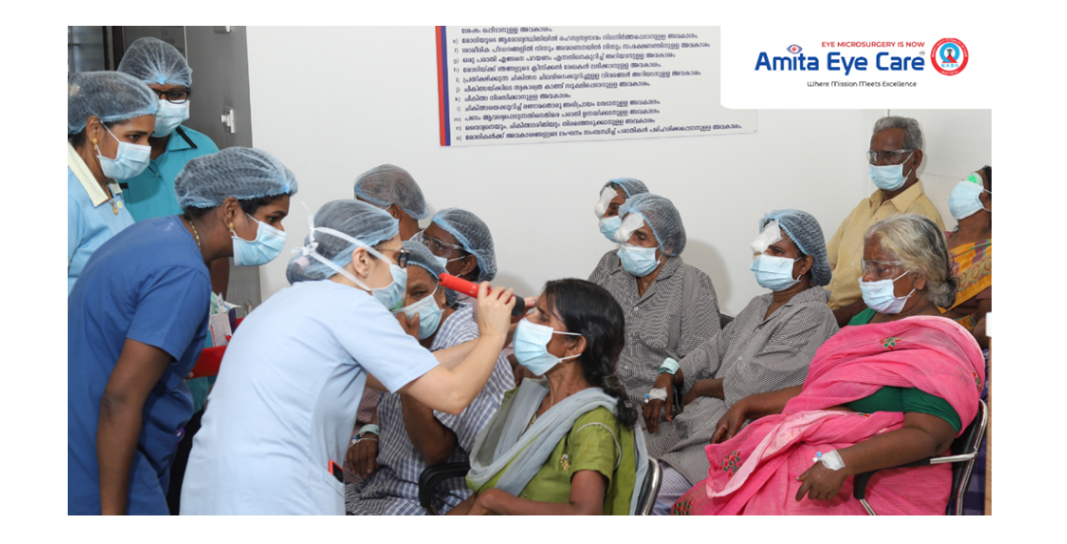
Kerala, [India], September 13th , 2025: The operating room at Amita Eye Care (A unit of Eye Microsurgery and Laser Center) in Thiruvalla buzzes with an unusual energy most mornings. While patients wait for their cataract surgeries, young doctors observe senior surgeons closely, watching each surgical step on TV monitors. This isn’t just patient care, it’s medical education in action.
Fellowship doctors demonstrate compassion while engaging with patients as they are wheeled into the operating room and later escorted to the postoperative recovery area. Additionally, they observe critical sterilization procedures and closely monitor the support provided by nursing staff throughout the surgical process. As part of their clinical exposure, they also participate in hands-on training under the direct supervision of the senior surgeon, gaining practical experience in a controlled and guided environment.



Since 2010, the eye hospital has quietly built one of Kerala’s most respected training programs for cataract surgery. Their phaco-cataract fellowship has graduated over 40 doctors—many now lead successful practices across India, while some continue to serve alongside the hospital team, contributing their expertise and care.
“We realized early that Kerala had a shortage of skilled cataract surgeons,” explains Dr. Amita Verghese, who co-founded the institution with Dr. Verghese Joseph in 1990. “Well-trained surgeons are needed to cure preventable blindness. Also, our skills should be passed on to the younger generations.”
The program stands out in the central Travancore region as one of the only institutions offering hands-on phacoemulsification training. The hospital’s four laminar-flow operating theaters, built in 2018, provide ideal learning environments.
Beyond fellowship programs, Amita Eye Care runs diploma courses in Optometry and Ophthalmic Technology for students who complete their higher secondary education in science. These two-year programs address another gap, the shortage of qualified technicians in eye care facilities. They train Optometrists, General Duty assistants, and Hospital Administrators who come to them as freshers from various colleges. The institute also plans to start more courses in the future.
The institution’s commitment to education extends to research. Doctors regularly publish findings in medical journals, contributing to global knowledge about eye care techniques and outcomes. Recent publications have covered topics ranging from diabetic retinopathy management to innovative surgical approaches. The doctors actively participate in CAHO and NABH programs regularly, staying updated with best practices to ensure the highest standards of patient care and hospital safety.
Training goals remain ambitious. The hospital plans to train more surgeons in the coming years, focusing on the healthcare needs of every patient in different age groups.
The ripple effect is measurable. Former fellows report performing multiple successful surgeries, extending the hospital’s impact far beyond Thiruvalla. For an institution that has been operating for three and a half decades, Amita Eye Care’s educational legacy has been making a bigger impact on the community than just treating patients.
Medical education rarely makes headlines, but its impact spreads quietly through improved patient care, one trained surgeon at a time.
For more information, visit: www.amitaeyecare.com